
  1
  2
  3
  4
  5
  6
  7
  8
  9
 10
 11
 12
 13
 14
 15
 16
 17
 18
 19
 20
 21
 22
 23
 24
 25
 26
 27
 28
 29
 30
 31
 32
 33
 34
 35
 36
 37
 38
 39
 40
 41
 42
 43
 44
 45
 46
 47
 48
 49
 50
 51
 52
 53
 54
 55
 56
 57
 58
 59
 60
 61
 62
 63
 64
 65
 66
 67
 68
 69
 70
 71
 72
 73
 74
 75
 76
 77
 78
 79
 80
 81
 82
 83
 84
 85
 86
 87
 88
 89
 90
 91
 92
 93
 94
 95
 96
 97
 98
 99
100
101
102
103
104
105
106
107
108
109
110
111
112
113
114
115
116
117
118
119
120
121
122
123
124
125
126
127
128
129
130
131
132
133
134
135
136
137
138
139
140
141
142
143
144
145
146
147
148
149
150
151
152
153
154
155
156
157
158
159
160
161
162
163
164
165
166
167
168
169
170
171
172
173
174
175
176
177
178
179
180
181
182
183
184
185
186
187
188
189
190
191
192
193
194
195
196
197
198
199
200
201
202
203
204
205
206
207
208
209
210
211
212
213
214
215
216
217
218
219
220
221
222
223
224
225
226
227
228
229
230
231
232
233
234
235
236
237
238
239
240
241
242
243
244
245
246
247
248
249
250
251
252
//! This is my solution for [Advent of Code - Day 24 - _Arithmetic Logic Unit_](https://adventofcode.com/2021/day/24)
//!
//! Today was a challenge of interpreting an assembly language adjacent program and working out the underlying logic
//! about which inputs it accepts or rejects. Looking through the puzzle data it seemed like a lot of statements were
//! no-ops so I first wondered if the puzzle was just to factor out the redundant commands and brute0force it, but after
//! a bit of trying to write a parser that would reduce the program to just the key bits in calculating the final `z`
//! value. This was a bit of a dead end, but did clue me into the repeating nature of the input. The no-op
//! operations we're repeated later on, but in the later context they did do something. Also I had written [parse_input]
//! and [`Instruction::from`], and [`Param`] and [`OpType`] to have a structured representation of the commands.
//!
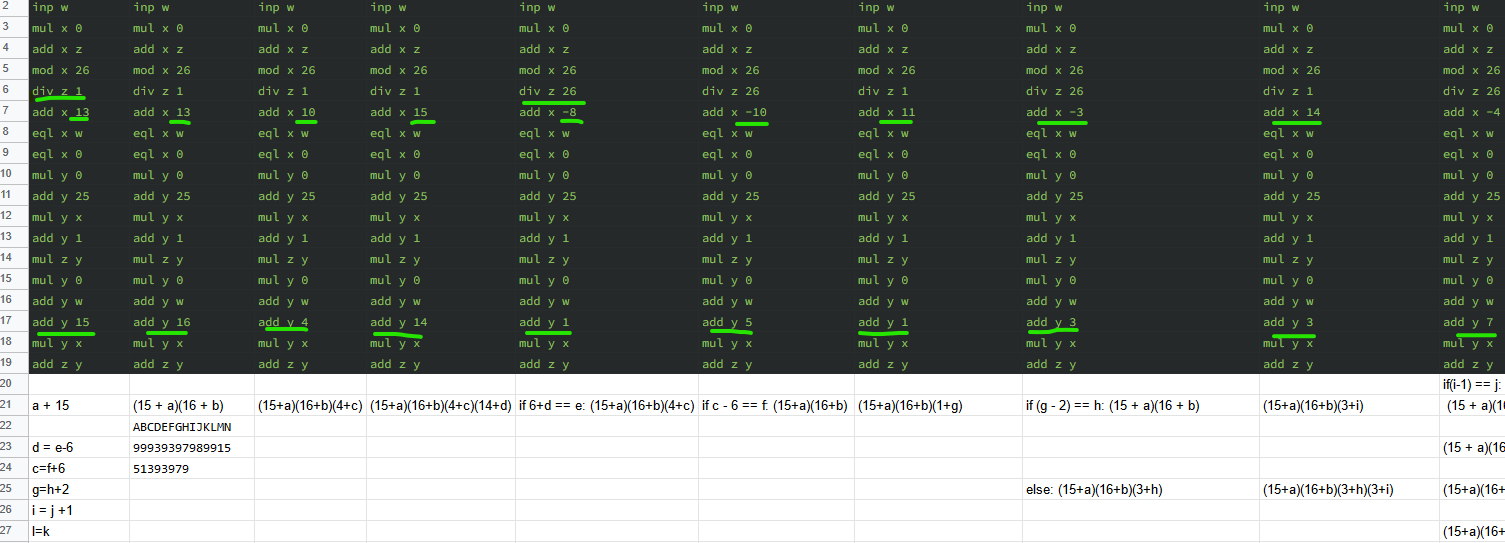
//! At this point I was working things out in a [rather disorganised spreadsheet](https://docs.google.com/spreadsheets/d/1EvNOOa-1rTDfxe4yj2pe-3x6HPskKhz1nLXUFkL9M64/edit)
//! Sheet 1 is me stepping through the logic. Copy of sheet 1 shows the program split into its repeating sections.
//!
//! 
//!
//! The MONAD program is a loop that repeats the same 18 lines, with a few variable values. Here is a walk through of
//! my first 18 line section:
//! ```text
//! 1. inp w | Read the next input into `w`
//! 2. mul x 0 | Reset `x` to 0
//! 3. add x z | Copy z into x
//! 4. mod x 26 | z is treated like a stack of base 26 numbers, this mod sets
//! | `x` to the top of the stack
//! 5. div z 1 | The number here is always 1 or 26. `z / 1` is a no-op,
//! | `z / 26` pops the `prev` number from the top of the `z`
//! | stack.
//! 6. add x 13 | The number here is variable per section, I'll call it `n`.
//! | This is adding `n` to `prev`.
//! 7. eql x w | `1` if `prev` + `n` == `inout` (`w` is the latest digit
//! | input.)
//! 8. eql x 0 | This is inverting line 7 so `prev` + `n` != `input`
//! 9. mul y 0 | Reset `y` to 0
//! 10. add y 25 | Set `y` to 25
//! 11. mul y x | `x` is 1 if the modified previous stack value != `input`, 0
//! | otherwise. So `y` is now either `0` or `25` based on the
//! | same condition.
//! 12. add y 1 | `y` is now either 1 or 26 based on the same condition.
//! 13. mul z y | If `y` is 1, then this is a no-op otherwise this is shifting
//! | 0 onto the top of the `z` stack
//! 14. mul y 0 | Reset `y` to 0 again
//! 15. add y w | Copy the input into `y`
//! 16. add y 15 | The literal here varies, I'll call it `p`.
//! 17. mul y x | Same idea as line 11, if `prev` + `n` != `input` this is a
//! | no-op, if `prev` + `n` == `input` y is now 0.
//! 18. add z y | If `y` is still non-zero, update the 0 we pushed onto the
//! | stack to be `input` + `p`.
//! ```
//!
//! So written as rust code this could be seen as:
//! ```rust
//! fn section(input: isize, z: &mut Vec<isize>, pop: bool, n: isize, p: isize) {
//! let x = z.last().unwrap() + n;
//!
//! if pop {z.pop()};
//!
//! if input != x {
//! z.push(input + p);
//! };
//! }
//! ```
//! It is also worth noting that as `input` is in the range `1` - `9`. So for some of the inputs it is guaranteed
//! that they'll be pushed onto the stack regardless of input. I stepped through the whole 14 sections by hand and
//! worked out that for z to be 0 (i.e. the stack is empty) each time `prev + n` could equal the input, it had to
//! match as the guaranteed pop operations matched the count of the guaranteed pushes, so each time it was possible
//! not to push we had to take it, or numbers would be left on the stack. This gave me the criteria for the valid
//! numbers. I made some human errors stepping through the constraints so the number I worked out failed, but since
//! this is a coding problem I should eliminate that by coding the analysis instead. [`analyse_program`] does just
//! that. Working out the maximum valid model number (part one), and then part two (the minimum) was a minor
//! modification.
//!
//! Overall, whilst there is some satisfaction in having worked out what was going on, I was not a fan of today's
//! puzzle. The answer was in deduction, so examples that actually helped a solver would have given the game away.
//! This meant the usual plan of build some tests from the example as a guide doesn't apply and makes the whole
//! experience more frustrating when it doesn't work (as it didn't for me when stepping through by hand). The only
//! feedback is that your answer is wrong, but you also can't go looking for hints as to why, as that gives the whole
//! game away.
use std::fs;
use crate::day_24::Instruction::{Inp, Op};
use crate::day_24::OpType::{Add, Div, Eql, Mod, Mul};
use crate::day_24::Param::{Lit, W, X, Y, Z};
/// Represents a operation's parameter(s) as either one of the four memory addresses or a literal number
#[derive(Eq, PartialEq, Debug, Copy, Clone)]
enum Param {
W,
X,
Y,
Z,
Lit(isize),
}
impl From<&str> for Param {
/// If the string parses as a number treat it as a literal, otherwise match it to a memory address or
/// panic if it's not valid.
fn from(s: &str) -> Self {
if let Ok(num) = s.parse() {
Lit(num)
} else {
match s {
"w" => W,
"x" => X,
"y" => Y,
"z" => Z,
_ => panic!("invalid param {}", s),
}
}
}
}
/// Whilst there are six instructions the `Inp` is different enough from the others that it is easier to split it out.
/// This then encodes the type of the remaining five op codes.
#[derive(Eq, PartialEq, Debug, Copy, Clone)]
enum OpType {
Add,
Mul,
Div,
Mod,
Eql,
}
/// Encode each line as either a read from input, or an operation
#[derive(Eq, PartialEq, Debug, Copy, Clone)]
enum Instruction {
Inp(Param),
Op(OpType, Param, Param),
}
impl From<&str> for Instruction {
/// Parses a line of the input
fn from(s: &str) -> Self {
let parts: Vec<&str> = s.split(" ").collect();
match parts[0] {
"inp" => Inp(Param::from(parts[1])),
"add" => Op(Add, Param::from(parts[1]), Param::from(parts[2])),
"mul" => Op(Mul, Param::from(parts[1]), Param::from(parts[2])),
"div" => Op(Div, Param::from(parts[1]), Param::from(parts[2])),
"mod" => Op(Mod, Param::from(parts[1]), Param::from(parts[2])),
"eql" => Op(Eql, Param::from(parts[1]), Param::from(parts[2])),
_ => panic!("invalid op: {}", s),
}
}
}
/// The entry point for running the solutions with the 'real' puzzle input.
///
/// - The puzzle input is expected to be at `<project_root>/res/day-24-input`
/// - It is expected this will be called by [`super::main()`] when the user elects to run day 24.
pub fn run() {
let contents = fs::read_to_string("res/day-24-input").expect("Failed to read file");
let program: Vec<Instruction> = parse_input(&contents);
let (min, max) = analyse_program(program);
println!("The maximum model number is {}.", max);
println!("The minimum model number is {}.", min);
}
/// Parse each line of the puzzle input program return with [`Instruction::from`], return the program as a list fo
/// instructions.
fn parse_input(input: &String) -> Vec<Instruction> {
input.lines().map(Instruction::from).collect()
}
/// First split the program into its 18-line sections. For each extract the three variables. Tracking what `input +
/// p` values are on the stack, and where it is possible to avoid pushing to the stack, storing that as a condition.
/// Then iterate through these conditions working out where parts of the input are constrained by them and updating the
/// minimum and maximum numbers as appropriate. Finally return this minimum (part two) and maximum (part one).
fn analyse_program(program: Vec<Instruction>) -> (isize, isize) {
// track the guaranteed push and pop operations
let mut stack: Vec<(usize, isize)> = Vec::new();
// track the conditions that prevent pushing to the stack
let mut conditions: Vec<(usize, usize, isize)> = Vec::new();
let chunks: Vec<Vec<Instruction>> = program.chunks(18).map(|chunk| chunk.to_vec()).collect();
chunks.iter().enumerate().for_each(|(i, chunk)| {
// peek at the top of the stack and account for it being empty for the first chunk.
let &(prev_key, prev_p) = stack.last().unwrap_or(&(0, 0));
// Line 5 (chunk lines are 0 indexed) is either 1 or 26. If it's 26 this causes a pop from the stack.
if let Op(Div, Z, Lit(div)) = chunk[4] {
if div == 26 {
stack.pop();
}
}
// Line 6 encodes `n`
if let Op(Add, X, Lit(n)) = chunk[5] {
// The previous input plus the previous `p` plus the current `n` must equal the current input to prevent
// pushing to the stack. Since prev input must be at least 1, if n + prev_p > 8 then input must be > 9,
// which is not possible. There is also a lower bound but that doesn't occur in the puzzle program.
if n + prev_p <= 8 {
// We have to prevent all unnecessary pushes, so record the condition that will prevent this push
conditions.push((i, prev_key, n + prev_p));
} else if let Op(Add, Y, Lit(p)) = chunk[15] {
// Otherwise record that this `input + p` must be pushed to the top of the stack
stack.push((i, p));
}
}
});
// Without conditions the min is 11111111111111 and the max is 99999999999999. Use these as starting values...
let mut min = [9; 14];
let mut max = [1; 14];
// then loop through the conditions applying their constraints, which are in the form `input_a` == `input_b` + `v`
for (a, b, v) in conditions {
// b - something == a so b can be as high as possible (9) a can be as low as possible (1) and a can only go
// up to `9 - mod(v)`, and b can only go down to `9 + mod(v)`
if v < 0 {
max[a] = 9 + v;
max[b] = 9;
min[b] = 1 - v;
min[a] = 1;
}
// otherwise v is positive and it works the other way round.
else {
max[b] = 9 - v;
max[a] = 9;
min[a] = 1 + v;
min[b] = 1;
}
}
// convert the calculated arrays of digits into numbers and return the min/max pair.
return (
min.iter().fold(0, |acc, &v| (acc * 10) + v),
max.iter().fold(0, |acc, &v| (acc * 10) + v),
);
}
#[cfg(test)]
mod tests {
use crate::day_24::parse_input;
use crate::day_24::Instruction::{Inp, Op};
use crate::day_24::OpType::{Eql, Mul};
use crate::day_24::Param::{Lit, X, Z};
#[test]
fn can_parse() {
assert_eq!(
parse_input(&"inp x\nmul x -1".to_string()),
Vec::from([Inp(X), Op(Mul, X, Lit(-1))])
);
assert_eq!(
parse_input(&"inp z\ninp x\nmul z 3\neql z x".to_string()),
Vec::from([Inp(Z), Inp(X), Op(Mul, Z, Lit(3)), Op(Eql, Z, X)])
)
}
}